


.png?width=50&height=50&name=feedbackfive-menu-icon(orange).png "feedbackfive-menu-icon(orange)")

Originally published on July 15, 2026, updated July 15, 2026
Menu
Join Our Email List
- Receive our monthly newsletter.
- Stay up to date on Amazon policies.
- Get tips to grow your business.
/%5BeComEngine%5DLogo-2019-linear.svg "eComEngine Logo")
 |
Review Monitoring Quickly identify review trends |
|
Review Monitoring Quickly identify review trends |

Every fall, Amazon sellers do the same thing: they look at last year’s bestsellers, place a big order, and call it “Q4 prep.” Feels productive. Looks proactive.
Except it’s often just expensive guessing.
Because here’s the uncomfortable truth about Q4 inventory planning for Amazon sellers: the SKUs that felt like winners last year aren’t automatically the SKUs that deserve your cash this year. Margins shift. Trends fade. Competitors undercut. And while you’re busy restocking nostalgia, Amazon is busy charging you premium rent to store it.
This is the Q4 inventory cash trap — and it’s sneakier than it sounds.
The trap isn’t “ordering too much inventory.” It’s ordering the wrong inventory at the worst possible time to be wrong.
Here’s the mechanism: Amazon calculates monthly storage fees based on the average number of units you store, and those fees scale with product size and the time of year. That second part is where sellers get squeezed.
The 3x Storage Fee Jump
Per 2026 fee structures, standard-size storage runs $0.78 per cubic foot from January through September — then jumps to $2.40 per cubic foot from October through December.
That’s not a typo. That’s a 3x increase, and it lands exactly when sellers are stockpiling the most product.
Source: Amazon Seller Central — Monthly Inventory Storage Fees
So if you over-order a slow-moving or low-margin SKU in August, you’re not just tying up cash. You’re paying triple rent on dead weight during the most expensive storage window of the year — while a higher-margin SKU might be sitting under-stocked and losing sales.
That’s the cash trap: money locked in boxes that aren’t earning their keep, during the exact season when capital efficiency matters most.
It’s rarely a math problem. It’s a timing and visibility problem:
Here’s where a lot of generic inventory advice falls apart: it treats every SKU like it’s on the same clock. It’s not.
If you’re sourcing domestically or from suppliers with quick turnaround, you’ve got more breathing room. You can use real September sell-through data, watch margin trends a little longer, and place a sharper, later-stage order. Your decision window might genuinely stretch into August or even early September.
If your product is coming from overseas — production time, customs, ocean freight, the whole chain — your real decision deadline isn’t “before Q4.” It’s months before Q4, often as early as May or June, just to land inventory before the October storage fee hike even kicks in.
By the time July and August roll around, long-lead-time sellers aren’t really “planning” anymore. They’re executing decisions that should’ve already been made.
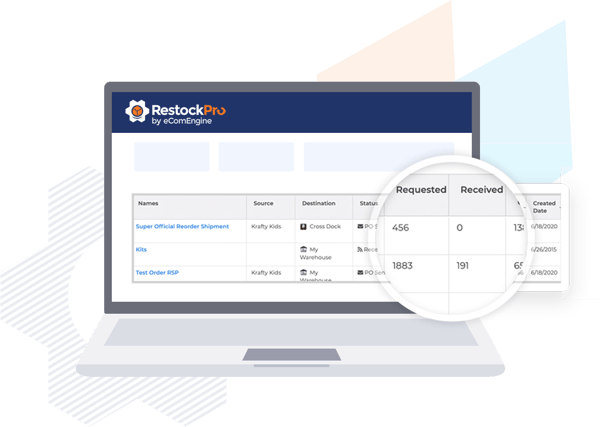
The takeaway: your Q4 strategy needs two timelines, not one. Treat short-lead and long-lead SKUs as separate planning tracks, or you’ll either order too late on the slow stuff or too early — and too generically — on everything else.
Once you accept that not every SKU deserves equal investment, the real question becomes: which ones actually earn Q4 cash?
This is where most sellers are flying blind — not because they lack data, but because their data lives in five different places (Seller Central reports, a spreadsheet, gut feeling, last year’s PO, and a Slack message from June). Profitability, sell-through speed, and storage cost all need to be looked at together, not separately.
Instead of asking “did this sell well?” ask three sharper questions:
Not revenue. Not units sold. Actual profit per unit after Amazon fees, storage costs, and COGS. A SKU that “sells like crazy” but nets pennies isn’t a Q4 priority — it’s a Q4 distraction.
Slow-moving inventory sitting in a warehouse during October–December isn’t just costing you storage fees — it’s costing you the opportunity to store something more profitable in that same space.
Be honest about which products have predictable, repeatable demand versus which ones rode a trend, a one-time promo, or a competitor’s stockout last year.
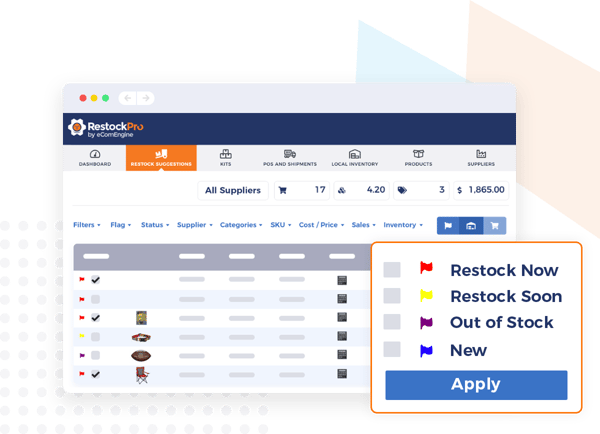
This is exactly the lens RestockPro’s SKU Economics feature gives you: a clear, side-by-side view of profitability and performance, so you can rank your catalog by what actually deserves Q4 cash — not just what’s familiar.
Before you place your next PO, run each SKU through this quick gut-check:
1. Margin check — Is this a top-margin performer, or just a top-seller?
2. Lead-time tag — Is this short-lead or long-lead? (This determines when you need to act, not just what you order.)
3. Storage cost math — At $2.40/cu ft in Q4, does the size-to-profit ratio still make sense?
4. Demand confidence — Trend-driven or proven repeatable seller?
5. Cash impact — If this order ties up capital for 90 days, is this the best use of that capital right now?
If a SKU can’t clear most of these, it might not deserve a big Q4 bet — even if it sold well in 2025.
Q4 inventory planning isn’t about ordering more. It’s about ordering smarter — putting your cash behind the SKUs with real margin, real velocity, and real demand confidence, instead of the ones that just feel familiar.
RestockPro takes the guesswork out of that decision, combining replenishment forecasting with SKU Economics so you can see, clearly, which products deserve your Q4 dollars before storage fees triple and your cash gets stuck in the wrong boxes.
Q: What is the Q4 inventory cash trap for Amazon sellers?
The Q4 inventory cash trap happens when sellers over-order low-margin or slow-moving SKUs ahead of the holiday season, tying up cash and warehouse space on products that don’t generate enough profit to justify the investment — right as Amazon’s storage fees rise sharply for the quarter.
Q: When do Amazon’s Q4 storage fees increase?
Amazon’s standard-size storage fees typically rise starting in October and remain elevated through December, reflecting peak holiday storage demand. For 2026, standard-size storage costs $0.78 per cubic foot from January through September, then increases to $2.40 per cubic foot from October through December.
Q: How far in advance should Amazon sellers plan Q4 inventory?
It depends on lead time. Sellers using overseas manufacturing and ocean freight should typically finalize Q4 inventory decisions by May or June to account for production and shipping time. Sellers with domestic or fast-turn suppliers have more flexibility and can often make sharper decisions later, sometimes into August or early September.
Q: How do I know which SKUs are worth restocking for Q4?
Prioritize SKUs based on three factors: actual profit margin after all fees, sell-through speed, and confidence in repeatable (not trend-driven) demand. Tools like RestockPro’s SKU Economics feature combine these data points so sellers can rank products by profitability rather than past sales volume alone.
Q: Why does a best-selling SKU sometimes lose money in Q4?
A high-velocity SKU can still carry thin margins once Amazon referral fees, fulfillment fees, and increased Q4 storage costs are factored in. Strong unit sales don’t guarantee strong profitability, especially during the months when storage fees triple.
Q: What’s the difference between short lead-time and long lead-time SKUs in Q4 planning?
Short lead-time SKUs, typically sourced domestically, can be reordered closer to Q4 using recent sales data. Long lead-time SKUs, usually manufactured overseas, require ordering months earlier to account for production and freight time, making early-year planning essential to avoid stockouts or rushed, costly orders.
Q: How can sellers avoid tying up cash in the wrong Q4 inventory?
Sellers can avoid this by evaluating SKUs on profitability and demand confidence before placing Q4 orders, rather than relying on previous year sales as the sole indicator. Using a defined inventory framework, like SKU Economics within RestockPro, helps allocate restock budget toward the products most likely to generate strong returns.
Don’t let guesswork decide where your Q4 cash goes. RestockPro helps you identify which SKUs actually deserve your inventory budget — before storage fees climb and your capital gets stuck in the wrong boxes.







No Comments Yet
Let us know what you think