


.png?width=50&height=50&name=feedbackfive-menu-icon(orange).png "feedbackfive-menu-icon(orange)")

Originally published on May 19, 2026, updated May 19, 2026
Menu
Join Our Email List
- Receive our monthly newsletter.
- Stay up to date on Amazon policies.
- Get tips to grow your business.
/%5BeComEngine%5DLogo-2019-linear.svg "eComEngine Logo")
 |
Review Monitoring Quickly identify review trends |
|
Review Monitoring Quickly identify review trends |

Revenue can be a wonderful thing.
It looks great in dashboards. It makes reports feel impressive. It gives everyone that satisfying “things are working” feeling.
Then you check the bank account.
And suddenly your “successful” Amazon business feels like it has been financially tackled by a very quiet linebacker.
For many Amazon sellers, the problem is not that the business is failing. It is that too much cash is trapped in inventory. Inventory is one of the easiest places for working capital to disappear because it often looks like growth. More units. More POs. More SKUs. More boxes moving around the supply chain like tiny cardboard confidence boosters.
But revenue is not cash flow.
And inventory is often the hidden reason a business can look healthy on paper while feeling tight, stressed, and strangely broke in real life.
That is why Amazon inventory cash flow deserves more attention. Not just once a year. Not just when your warehouse starts looking like a cardboard jungle. And definitely not only after you have already overbought, stocked out, or buried cash in slow-moving products that now have the emotional energy of an awkward dinner guest who refuses to leave.
The good news? Inventory chaos is not inevitable. With better forecasting, smarter guardrails, and a more disciplined restocking process, Amazon sellers can protect working capital while still staying ready to meet demand.
And yes, that is exactly where RestockPro fits in.
Revenue tells you what sold.
Cash flow tells you what survived.
That difference matters because sales can increase while your available cash shrinks. It happens when your business grows in a way that demands more inventory, more storage, more freight, more prep, more reorders, and more capital tied up before the money comes back around.
For Amazon sellers, the cash cycle can feel especially tricky because inventory is purchased before it produces revenue. You pay suppliers. You wait for production. You wait for shipping. You wait for receiving. You wait for FBA availability. You wait for sales. You wait for payouts.
That is a lot of waiting for a business that still has bills arriving with the punctuality of a Swiss train and the charm of a raccoon in your garage.
When inventory planning is loose, the business starts operating in a constant squeeze:
You reorder too much because you are afraid of stockouts.
You reorder too little because cash is tight.
You chase your bestsellers while ignoring your slow movers.
You use last month’s sales as your crystal ball, even though last month had a promotion, a seasonal spike, or a competitor who temporarily vanished like a magician with poor inventory controls.
Eventually, your revenue looks fine, but your cash is stuck in products that are not turning quickly enough.
That is the “successful but broke” problem.
Inventory distortion is the cost of having the wrong amount of inventory in the wrong place at the wrong time. In plain English: too much of what is not moving, not enough of what is.
According to IHL Group, global retail loses roughly $1.73 trillion annually due to inventory distortion, which includes the combined cost of out-of-stocks and overstocks. IHL also reported that this problem persists despite significant improvements in inventory operations.
That number is enormous. It is not “oops, we bought too many novelty mugs” enormous. It is “this could be its own economy with a suspiciously expensive flag” enormous.
For Amazon sellers, the same basic inventory distortion problem shows up in very practical ways:
And the worst part? These issues often happen at the same time. A seller may be overstocked on underperformers while simultaneously running dangerously low on profitable winners.
That is how cash gets stuck and opportunity gets missed.
Most overbuy cycles do not begin with bad intentions.
They usually start with something that feels perfectly reasonable.
A product sells well for a few weeks. You get excited. You reorder aggressively. Maybe you factor in future growth. Maybe you increase the PO because the supplier offers a price break. Maybe you panic because the last stockout hurt your ranking, your sales, your sleep, and possibly your relationship with caffeine.
So you buy more.
Then demand cools.
Now you are sitting on extra inventory. Your cash is tied up. Your storage costs increase. You hesitate to reorder other SKUs because there is not enough cash available. Then your actual winners start getting too close to stockout.
Congratulations. You have entered the overbuy cycle, the least fun amusement park ride in ecommerce.
Overbuying often comes from a few repeat offenders:
Slow-moving inventory does not always feel urgent because it is not as dramatic as a stockout.
A stockout screams.
Slow inventory whispers.
It quietly takes up storage space. It quietly drains working capital. It quietly makes your balance sheet look asset-rich while your bank account looks like it needs a motivational podcast.
This is why inventory cash flow can be so deceptive. Inventory is technically an asset, but it is not usable cash until it sells profitably. A pallet of slow-moving units cannot pay your supplier deposit. It cannot fund your next bestseller reorder. It cannot cover ad spend, payroll, software, freight, or that surprise expense that appears every time a business owner dares to feel relaxed.
The longer inventory sits, the more problems it can create:
The biggest cost of excess inventory is not always the product itself. It is the better decision you could not afford to make because your cash was already committed.
Overbuying is a cash flow problem.
Stockouts are also a cash flow problem.
That is the annoying part. Inventory planning lives in the middle. Buy too much, and cash gets trapped. Buy too little, and sales disappear.
When a profitable Amazon SKU stocks out, the damage can ripple across the business. You miss sales. Your ranking may suffer. Competitors may win customers you worked hard to attract. Your ad momentum can stall. Your future demand becomes harder to forecast because your sales history now includes a period where you could not sell what shoppers wanted to buy.
Stockouts also create psychological pressure. After one painful stockout, sellers often overcorrect by buying too much the next time.
That is how the pendulum swings:
The goal is not to choose between avoiding stockouts and protecting cash. The goal is to create inventory guardrails that help you do both.
Inventory guardrails are rules and decision points that keep your buying process grounded in data instead of panic, optimism, or the thrilling but unreliable strategy known as “I think this should sell.”
Here are the guardrails every Amazon seller should consider.
Each SKU should have its own restocking logic based on sales velocity, lead time, profitability, seasonality, supplier constraints, and risk tolerance.
Your bestsellers may need tighter monitoring and deeper coverage. Your slower movers may need conservative reorders or no reorders at all until they prove they deserve more capital.
The key is to stop asking, “Should we reorder inventory?”
Ask, “Which SKUs deserve cash right now?”
That one question can change the entire financial rhythm of the business.
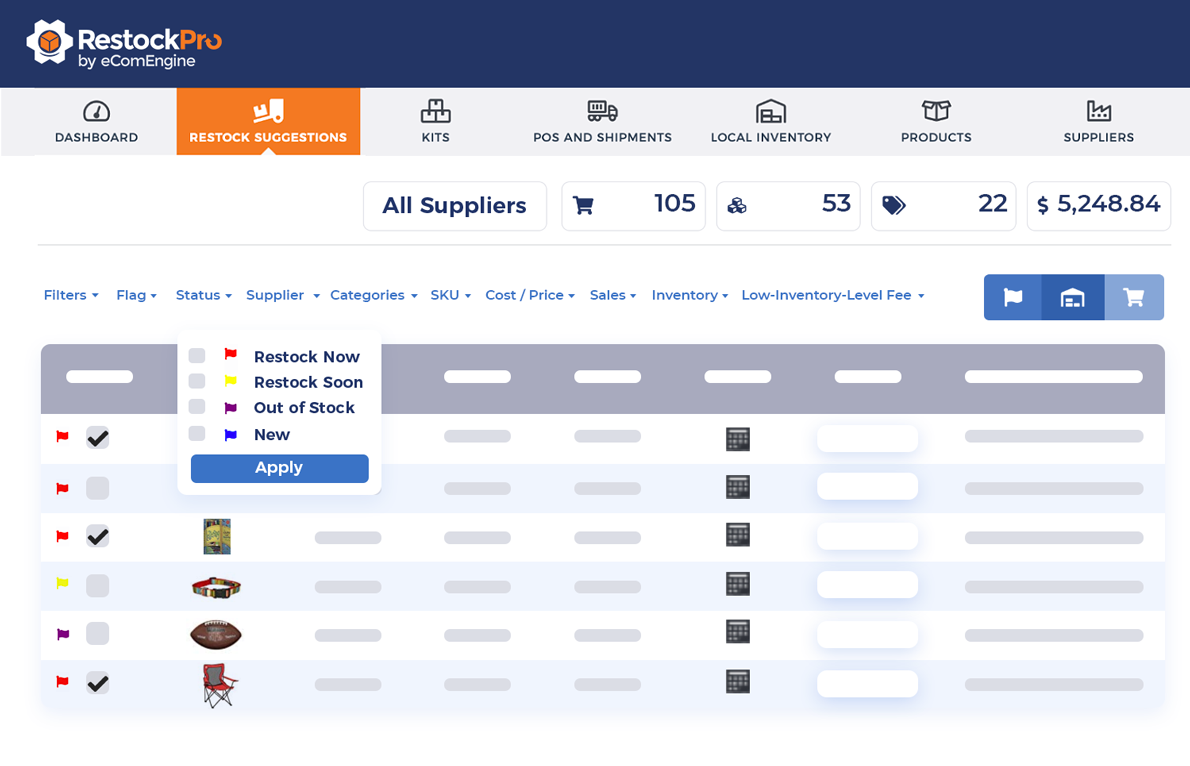
Not all products deserve the same treatment.
Group your SKUs into practical categories:
Winners: Strong sales velocity, healthy margins, reliable demand.
Watchlist SKUs: Mixed signals, seasonal dependency, margin pressure, or inconsistent demand.
Cash traps: Slow-moving inventory, low margin, poor replenishment history, or products that require too much capital for too little return.
This keeps your inventory planning focused on capital allocation, not just replenishment.
Because “we have inventory” is not the same as “we have inventory worth buying again.”
Demand planning should account for sales history, recent velocity, seasonal trends, promotions, stockout periods, and supplier timelines.
A good forecast is not a fortune cookie. It should not say, “Great success is coming soon,” then leave you with 700 unsold units and a mild eye twitch.
Look at what customers are actually buying. Adjust for unusual spikes. Watch for trend changes. Review SKU-level sales patterns before creating purchase orders.
Restocking should follow demand, not ego.
Adding products can feel like growth.
Sometimes it is.
Sometimes it is just a more expensive way to create operational clutter.
Before expanding your catalog, make sure your current winners are properly funded. If cash is limited, prioritize proven products before speculative buys.
A new SKU might be exciting, but your reliable bestseller is the one quietly paying the bills and asking for very little recognition.
Give it the respect it deserves.
Every PO should answer a few basic questions:
Which SKUs are driving profitable demand?
Which SKUs are already overstocked?
Which SKUs are at risk of stockout?
Which products have changing velocity?
Which items are tying up cash without earning their keep?
Which supplier orders should be delayed, reduced, or split?
This does not need to become a 47-step ritual involving a whiteboard, three meetings, and someone named Kevin saying, “Let’s circle back.”
But it does need to happen consistently.
Manual inventory planning gets messy fast.
At first, a spreadsheet feels manageable. Then you add more SKUs. More suppliers. More lead times. More FBA shipments. More seasonal patterns. More exceptions. More formulas that only one person understands and that person is currently on vacation, unreachable, and possibly living their best life.
RestockPro helps Amazon FBA sellers simplify inventory management by streamlining forecasting, reordering, purchase orders, shipments, item labeling, and inventory visibility. eComEngine describes RestockPro as an FBA inventory management tool that helps sellers determine what to restock and when while staying in stock without overstocking.
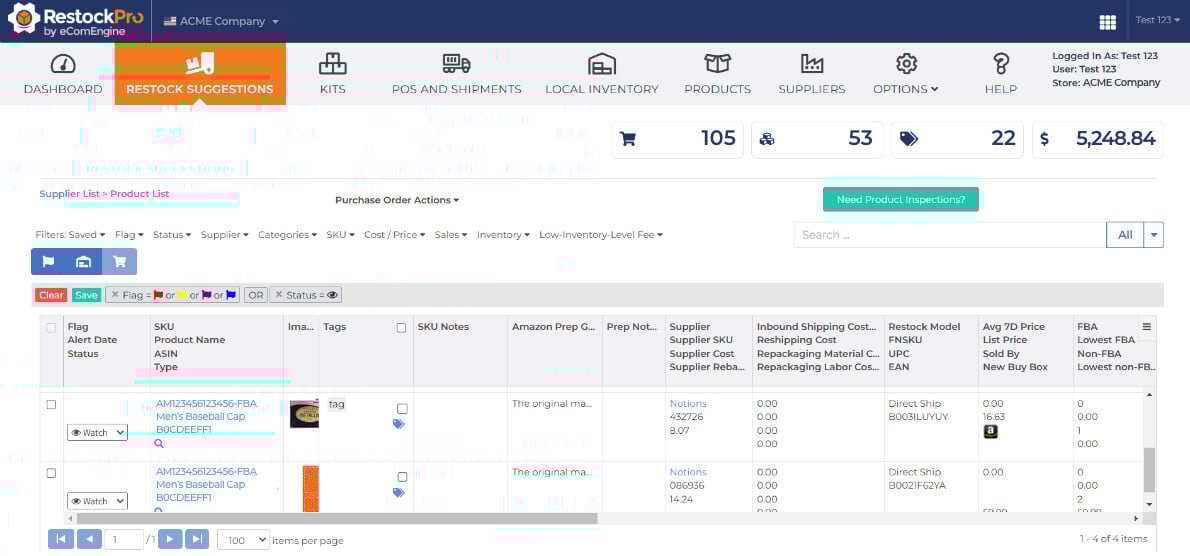
That matters because Amazon inventory cash flow is not just about buying less.
It is about buying smarter.
RestockPro helps sellers make replenishment decisions using more structured inventory logic, so they can align buys to real demand instead of relying on gut feel, incomplete spreadsheets, or the dangerous confidence that comes from “last month was pretty good.”
The most important inventory questions are not complicated. They are just hard to answer manually at scale.
What needs to be reordered?
How much should be reordered?
When should the reorder happen?
Which products are moving fast enough to deserve more cash?
Which products are sitting too long?
Which supplier orders should be prioritized?
How much inventory coverage do we actually have?
Which SKUs are creating risk?
Those questions are the difference between reactive buying and disciplined inventory planning.
And disciplined inventory planning is how Amazon sellers stop feeling successful but broke.
Avoiding overbuy cycles requires a shift in thinking.
Instead of treating inventory as a growth trophy, treat it as working capital that must earn its place.
Every reorder should have a job.
Every SKU should justify the cash it receives.
Every purchase order should support real demand, not just the emotional need to “be safe.”
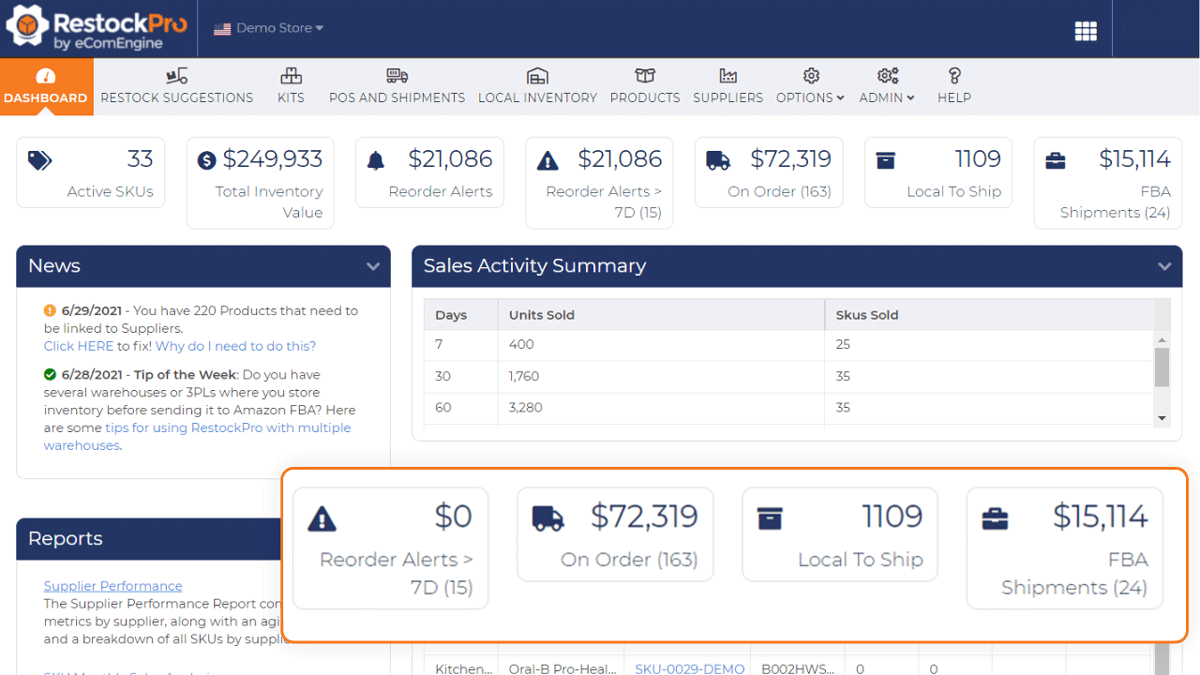
Here is a practical restocking framework sellers can use.
Start with the products that consistently generate profitable sales. These are the SKUs that should receive priority when cash is limited.
Look at velocity, margin, reorder history, seasonality, and operational complexity. A product that sells well but creates constant return problems, fee issues, or margin pressure may not be as healthy as it looks.
The goal is not just sales volume.
The goal is profitable movement.
Slow-moving inventory needs attention before it becomes dead inventory.
Review products with excess days of supply, declining velocity, or weak reorder justification. Decide whether to pause reorders, reduce future buys, bundle products, adjust pricing, create a promotion, or liquidate.
The sooner you identify these SKUs, the more options you have.
Waiting too long usually turns “strategic inventory adjustment” into “please take these units, we are emotionally tired.”
Coverage targets help sellers avoid both underbuying and overbuying.
Instead of ordering a random quantity or simply repeating the last PO, define how much inventory coverage each SKU needs based on sales velocity and lead time.
A fast-moving, high-margin SKU with a long supplier lead time may need more coverage.
A slower-moving SKU with uncertain demand may need less.
That is how you keep inventory decisions connected to cash reality.
Before placing a PO, check whether recent demand is normal, inflated, or declining.
Did a promotion temporarily boost sales?
Did a competitor stockout increase demand?
Did reviews improve conversion?
Did pricing change?
Did seasonality affect volume?
Did a stockout distort sales history?
A reorder based on distorted demand can create distorted inventory. And distorted inventory is where cash flow goes to do sad little laps around your business.
Some SKUs should not be automatically reordered.
If a product has declining velocity, weak margins, high return risk, excess coverage, or inconsistent demand, require an extra review before approving another buy.
This one rule can prevent a surprising amount of cash from being poured into products that do not deserve it.
A little friction in the buying process can save a lot of financial regret.
Amazon sellers often talk about staying in stock as if the only solution is buying more inventory.
But buying more is not the same as planning better.
The better goal is to stay in stock without overstocking.
That means you need visibility into demand, reorder timing, supplier timelines, SKU-level performance, and inventory coverage. It means every buy should be connected to a clear reason. It means your inventory strategy should protect both sales and working capital.
Because cash flow does not improve just because inventory exists.
Cash flow improves when the right inventory sells at the right time at the right margin.
That is the whole game.
Well, that and trying to understand Amazon reports without whispering, “Who designed this?” into the void.
Your Amazon business should not feel broke just because it is growing.
If too much cash is trapped in inventory, it is time to tighten the way you forecast, reorder, and prioritize SKUs.
RestockPro helps Amazon FBA sellers align inventory buys to real demand, protect working capital, and make smarter replenishment decisions before cash gets stuck in the wrong products.
Stop guessing what to reorder.
Start restocking with a plan.
Q: What is Amazon inventory cash flow?
Amazon inventory cash flow is the movement of cash into and out of inventory-related decisions, including purchasing, replenishment, storage, sales, and payouts. When sellers overbuy, cash gets tied up in products that may not sell quickly. When sellers underbuy, they risk stockouts and lost sales. Healthy inventory cash flow means inventory is turning efficiently and supporting profitable growth.
Q: Why does my Amazon business feel successful but broke?
Your Amazon business may feel successful but broke if revenue is strong but too much cash is tied up in inventory, supplier payments, freight, storage, or slow-moving SKUs. Sales can look healthy while available cash remains tight because inventory must be purchased before it turns back into revenue.
Q: How does overstocking hurt Amazon sellers?
Overstocking hurts Amazon sellers by tying up working capital, increasing storage pressure, creating markdown risk, and limiting the ability to reorder better-performing products. Excess inventory can make a business look asset-rich while leaving very little cash available for growth.
Q: How do stockouts affect cash flow?
Stockouts affect cash flow by causing missed sales, lost momentum, potential ranking declines, and delayed revenue. They can also lead sellers to overcorrect with aggressive future reorders, which may create excess inventory and another cash crunch.
Q: How can Amazon sellers avoid overbuying inventory?
Amazon sellers can avoid overbuying by using SKU-level demand forecasting, setting reorder rules, reviewing sales velocity, accounting for supplier lead times, and separating proven winners from slow-moving products. The key is to base purchase orders on real demand rather than fear, optimism, or last month’s unusual sales spike.
Q: How does RestockPro help with inventory cash flow?
RestockPro helps Amazon FBA sellers forecast demand, manage replenishment, create purchase orders, monitor shipments, and make smarter restocking decisions. By helping sellers understand what to restock and when, RestockPro supports better inventory cash flow and helps reduce the risk of both stockouts and overstocks.






No Comments Yet
Let us know what you think