


.png?width=50&height=50&name=feedbackfive-menu-icon(orange).png "feedbackfive-menu-icon(orange)")
Originally published on March 4, 2026, updated April 10, 2026
Menu
Join Our Email List
- Receive our monthly newsletter.
- Stay up to date on Amazon policies.
- Get tips to grow your business.
/%5BeComEngine%5DLogo-2019-linear.svg "eComEngine Logo")
 |
Review Monitoring Quickly identify review trends |
|
Review Monitoring Quickly identify review trends |

Amazon sellers love “growth hacks.” But the most reliable conversion lever is hiding in plain sight… quietly doing pushups in your reviews section.
Here’s the loop most sellers have… but don’t intentionally build:
Review velocity → trust → conversion → sales → more review opportunities → (back to) review velocity
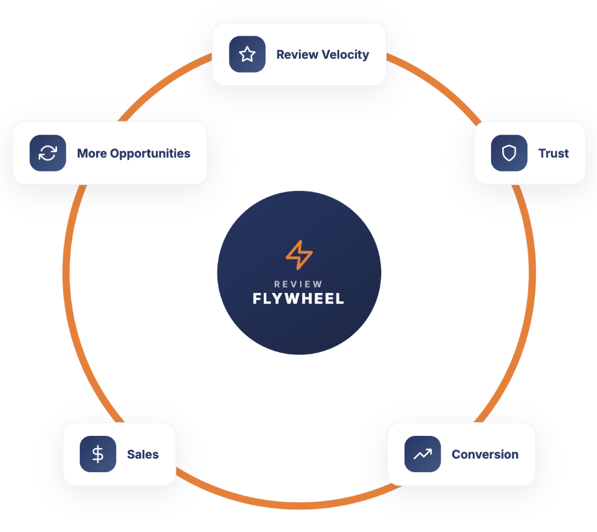
That's the Amazon review flywheel. And when it’s spinning, your listing gets easier to sell without you constantly turning ads into gasoline and lighting it on fire.
Let’s connect the dots, then give you a simple system to keep the wheel turning.
Reviews don’t just make shoppers feel warm and fuzzy. They change behavior.
Translation: if your review section is thin, stale, or nonexistent, you’re not “missing a nice-to-have.” You’re actively leaking conversions.
The flywheel has 5 stages
Then it loops.
How sellers break it (without realizing it)
Most flywheels fail at Stage 1 because sellers:
A flywheel doesn’t spin because you want it to. It spins because you systemize it.
A pile of old reviews is helpful.
A steady stream of recent reviews is powerful.
Why? Because shoppers don’t just look for good reviews, they look for current reviews that answer their real questions today:
When review velocity is healthy, your listing feels alive. When it’s not, even a 4.6-star average can feel… suspiciously quiet.
Once you’ve got consistent reviews coming in, trust increases in a very practical way:
That’s why research consistently ties reviews to conversion lift - reviews reduce uncertainty, and uncertainty is the #1 enemy of checkout buttons.
And the absence of reviews is a conversion killer: nearly half of consumers won’t buy without them.
Here’s the part that’s easy to miss:
When conversion improves, your sales rise without needing proportionally more traffic.
That means:
That’s the compounding loop. It’s not magic, it’s momentum.
You don’t need a 37-step SOP. You simply need a repeatable rhythm.
Choose:
These are your “flywheel priorities.”
No need to overcomplicate it. Start with a practical baseline:
You’re aiming for steady, not viral.
Every week, review:
This turns reviews into both conversion fuel and conversion intel.
If review velocity is the engine, automation is the oil change you keep ignoring until the dashboard starts screaming.
The point isn’t to “send more requests.”
The point is to run a consistent, compliant review engine that keeps the flywheel spinning, without adding more tasks to your day.
That’s a velocity problem. Set a goal for “freshness” and build a weekly habit to sustain it.
Look for patterns in negative/neutral reviews:
Then update the listing to address those objections directly.
Bad reviews are feedback in disguise. The flywheel doesn’t require perfection. It requires credibility, and credibility comes from real customers sharing real experiences.
You can absolutely run this manually.
You can also decide that your time is worth more than copy/pasting “please leave a review” into the void.
Activate your flywheel with FeedbackFive
Build consistent review velocity, strengthen trust, lift conversion, and create more review opportunities… on repeat.
If your reviews are already good, this makes them work harder. If your reviews are thin, this helps you fix the leak where it matters most: conversion.
The Amazon review flywheel is simple: more reviews build more trust, trust lifts conversion, conversion drives sales, and sales create more chances for reviews… so the loop keeps compounding
That’s not a gimmick. That’s the game.
Q: What is the Amazon Review Flywheel?
It’s a simple compounding loop: more (recent) reviews → more trust → better conversion → more sales → more customers who can leave reviews → repeat.
When the flywheel is running, your listing doesn’t have to “work as hard” to earn the click and the purchase.
Q: What does “review velocity” mean, and why does it matter?
Review velocity = how consistently new reviews show up over time (weekly/monthly), not just your total count. Shoppers don’t only ask “Is it good?” - they ask “Is it still good now?” A steady trickle of recent reviews keeps trust fresh and conversion-ready.
Q: How many reviews do I need before I see a conversion lift?
There’s no universal number, because categories and price points vary. But there is a universal truth: going from “no reviews” to “some reviews” is one of the biggest trust jumps you can make. After that, the goal becomes consistency, keeping reviews coming in so your listing never feels “quiet.”
Q: What’s the best way to get more Amazon reviews without breaking policy?
Keep it compliant and consistent:
A tool like FeedbackFive helps you keep review requests consistent at scale, so your flywheel doesn’t stall when life gets busy.
Q: Should I prioritize increasing my star rating or increasing my review count?
Think of it like this:
A strong average rating helps, but recent reviews and steady velocity often do more to reduce buyer hesitation, especially if your category is competitive.
Q: Can negative reviews hurt the flywheel?
A few negatives won’t “break” the flywheel, but ignoring them can. Negative reviews are basically free conversion research. Use them to:
When objections go down, conversion goes up… and the flywheel speeds up.
Q: How do I know if my flywheel is working?
Watch these trends on your priority SKUs:
If velocity rises and conversion follows, congrats, your flywheel is officially spinning.







No Comments Yet
Let us know what you think