


.png?width=50&height=50&name=feedbackfive-menu-icon(orange).png "feedbackfive-menu-icon(orange)")

Originally published on May 5, 2026, updated May 5, 2026
Menu
Join Our Email List
- Receive our monthly newsletter.
- Stay up to date on Amazon policies.
- Get tips to grow your business.
/%5BeComEngine%5DLogo-2019-linear.svg "eComEngine Logo")
 |
Review Monitoring Quickly identify review trends |
|
Review Monitoring Quickly identify review trends |

Discounting is easy.
Too easy, honestly.
It’s the eCommerce equivalent of duct tape: useful in the right moment, wildly overused, and occasionally hiding a much bigger problem underneath.
For Amazon sellers, promotions can absolutely serve a purpose. A smart coupon, limited-time deal, launch offer, or seasonal push can help increase visibility, move inventory, and create momentum. But when discounting becomes the default way to compete, it can quietly train shoppers to wait, compare, hesitate, and buy only when the price drops.
That is not a growth strategy. That is a treadmill with fees.
The better play? Build the kind of product-page trust that makes shoppers feel confident buying without needing a 20% nudge and a flashing coupon badge to get there.
That is where reviews come in.
Reviews create social proof. Social proof creates confidence. Confidence creates pricing power. And pricing power helps sellers protect margins instead of constantly sacrificing them on the altar of “just one more promo.”
According to PowerReviews, 98% of shoppers say reviews are an essential resource when making purchase decisions, and 93% say ratings and reviews impact whether they buy a product. Nearly half of shoppers, 45%, say they will not purchase a product if there are no ratings or reviews available.
In other words, reviews are not just nice-to-have trust glitter sprinkled on your listing.
They are margin protection.
On Amazon, discounting can feel like a practical answer to a very real problem.
Sales slowing down? Discount.
Competitor dropped their price? Discount.
New product needs traction? Discount.
Buy Box drama? Discount, panic, refresh dashboard, repeat.
The problem is that discounts don’t only reduce price. They reduce flexibility.
Every percentage point you shave off the selling price has to be made up somewhere else, and Amazon sellers already have plenty of margin goblins waiting in the wings: referral fees, FBA fees, storage fees, ad costs, returns, logistics, product costs, and the mysterious “why is this suddenly more expensive?” category that seems to appear right when you’re trying to have a normal Tuesday.
When sellers rely too heavily on promotions, they may win the order but weaken the business. More units can move while less profit lands. Revenue can look busy while margin quietly packs a bag and leaves.
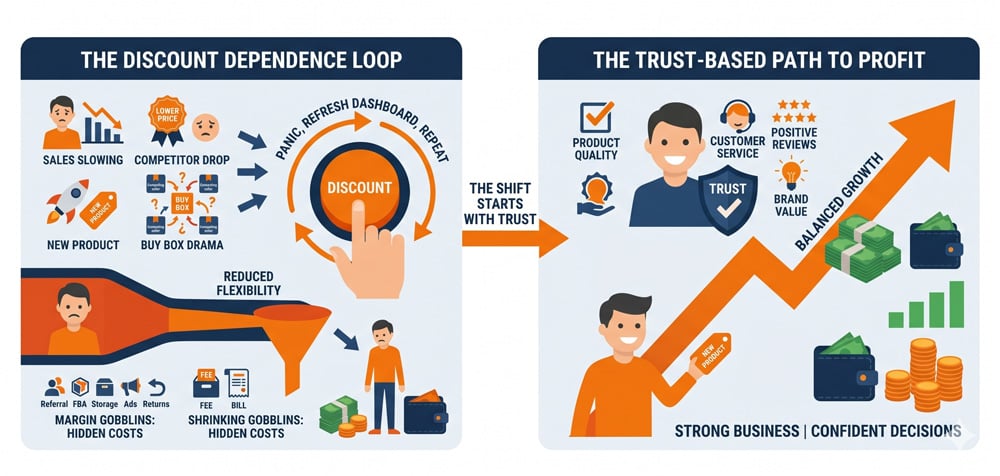
The goal is not to eliminate discounts entirely. The goal is to stop needing them as the main reason a shopper chooses your product.
That shift starts with trust.
Price matters. Of course it does.
But shoppers rarely make decisions on price alone, especially when the product feels unfamiliar, risky, expensive, personal, giftable, or difficult to evaluate from a few product photos.
PowerReviews found that 78% of consumers say the more expensive the product, the more they read reviews. Nearly all shoppers, 98%, are more likely to read reviews for a product they have never purchased before.
That matters for Amazon sellers because many buying decisions are not simply “which product is cheapest?”
They are closer to:
“Which product feels like the safest choice?”
Reviews help answer that question.
They show shoppers that other people bought the product, received it, used it, and had something to say about it. That creates a confidence bridge between product curiosity and purchase action.
Without reviews, shoppers have to rely more heavily on price, brand recognition, product images, bullets, and whatever emotional support they can find from zooming in on the main image for the eighth time.
With reviews, shoppers get proof.
And proof can reduce the need for promos.
Pricing power is the ability to maintain a healthier price because customers believe the product is worth it.
That does not mean charging more simply because you feel bold after your second coffee. It means your listing gives shoppers enough confidence to choose your product even when another option is cheaper.
Reviews help create that confidence in several ways.
Every purchase carries some level of risk. Will it work? Will it fit? Will it arrive as expected? Will it look like the photos? Will it last? Will the person receiving it as a gift immediately judge my life choices?
Reviews reduce that uncertainty by giving shoppers real-world context.
A strong product description can make a promise. Reviews help validate whether buyers believe that promise was kept.
A listing with recent, relevant reviews feels alive. It signals that people are still buying, using, and responding to the product.
That matters because stale social proof can feel almost as suspicious as no social proof. Shoppers want reassurance that the product is still delivering today, not just that it made someone happy during a different era of shipping costs and lower blood pressure.
Amazon shoppers compare. That’s what they do. They open tabs, scan ratings, skim review counts, filter by recent reviews, and look for comments that match their own concerns.
A strong review profile gives them more reasons to stay with your listing instead of drifting to a competitor with lower pricing.
When a shopper sees consistent positive feedback around quality, durability, ease of use, packaging, support, or results, your product has more room to compete on value instead of price alone.
That is the difference between “this costs more” and “this looks worth more.”
Tiny wording difference. Massive margin difference.
Not all review profiles create the same level of confidence.
A product with a strong average rating but only a handful of reviews may still feel risky. A product with hundreds of reviews but frequent complaints about the same issue may create hesitation. A product with older reviews but limited recent activity may raise questions about current quality.
To reduce discount dependence, sellers need reviews that help shoppers answer the questions they already have.
A healthy review count helps show that your product has been purchased and evaluated by enough people to feel credible.
This is especially important for newer products, competitive categories, and products where shoppers are comparing multiple similar options.
Detailed reviews often carry more persuasive power than vague comments.
“Great product” is helpful.
“Used this every day for three months, still works perfectly, and the setup took less than five minutes” is the kind of review that walks into the room wearing a tiny salesperson blazer.
Review quality helps shoppers understand why people like the product, how they use it, and whether it fits their own needs.
Recent reviews reassure shoppers that the product still performs well, the listing is active, and the seller is still delivering a solid experience.
PowerReviews’ more recent ratings and reviews guide notes that 96% of consumers say they read more reviews when shopping for expensive products, and 99% are more likely to read reviews for a product they have never purchased before.
For sellers trying to protect margin, that means review recency should not be treated as a vanity metric. It is part of the trust engine.
The best reviews often speak directly to shopper objections.
For example:
When reviews answer these questions naturally, shoppers need less convincing from discounts.
Reviews do not magically create margin by themselves. Amazon is not handing out profit confetti just because someone typed “works great.”
The connection is more practical.
Strong reviews can improve shopper confidence, which can improve conversion. Better conversion can make ad traffic more efficient. More efficient traffic can reduce the pressure to use aggressive discounts to force purchases. Less discount pressure can help protect margin.
That is the flywheel.
| THE COMPOUNDING EFFECT | |||||||||||||||
| How trust transforms into margin. | |||||||||||||||
|
And yes, “margin potential” is doing important work there. Reviews are not a guarantee that every shopper will pay full price. But they do create stronger conditions for shoppers to choose value over the lowest possible price.
That matters because many Amazon sellers do not have a traffic problem as much as they have a trust-to-conversion problem.
They can get shoppers to the page.
The question is whether the listing gives shoppers enough confidence to buy without needing a discount to settle the argument.
If you are paying for Amazon Ads, review strength becomes even more important.
Ad spend gets shoppers to the listing. Reviews help convince them to buy once they arrive.
When a seller drives paid traffic to a product with weak social proof, they may need heavier discounts to improve conversion. That means the seller is paying to bring traffic in and then paying again through margin loss to push the shopper over the line.
That is a very expensive group project.
A stronger review profile can help your product page do more of the selling once shoppers arrive. It gives your ads a better chance of turning clicks into orders without making discounts the hero of the story.
The discount should not have to carry the whole listing on its back like it’s in an eCommerce CrossFit competition.
Amazon sellers need reviews, but they also need to stay compliant. That means no incentives, no pressure, no review gating, and no “please leave us five stars or our warehouse mascot will be sad” messaging.
The safest long-term approach is simple: consistently request honest reviews in a compliant way.
Amazon’s Request a Review feature allows sellers to request a review once per order between 5 and 30 days after delivery.
That window matters because timing can influence whether the buyer has actually used the product and still remembers the purchase. Too early, and they may not be ready. Too late, and your product may have become one more blurry memory in the great cardboard river of online shopping.
FeedbackFive helps Amazon sellers build trust at scale by automating the review request process.
Instead of manually clicking Amazon’s Request a Review button order by order, FeedbackFive can automatically trigger Amazon’s Request a Review button for your orders. Those requests are sent by Amazon on your behalf, using Amazon’s preferred messaging.
That matters because consistency is where many sellers fall short.
Manual review requests work when someone remembers to do them. Automation works when the team is busy, sales volume increases, or everyone is knee-deep in inventory planning, ad optimization, customer support, and trying to understand why one SKU suddenly decided to behave like a raccoon in a vending machine.
FeedbackFive also allows sellers to automate requests within Amazon’s 5–30 day window, choose which orders qualify, and send requests based on campaign settings. In a random sample of more than 1,200 FeedbackFive users, average daily reviews increased 41% within 10 days of activating the Amazon Feedback and Review Request Template.
That is the kind of operational habit that can strengthen a seller’s reputation over time.
Not by chasing reviews desperately.
By building a repeatable system.
Reviews are not just sales assets. They are product intelligence.
When shoppers repeatedly praise the same feature, you learn what your product is already winning on. That can shape listing copy, image strategy, A+ Content, ads, and positioning.
When shoppers repeatedly complain about the same issue, you have a margin problem hiding inside a customer experience problem.
Common review themes can reveal:
If buyers mention damaged items, messy packaging, missing parts, or poor presentation, those issues can create returns, refunds, replacement costs, and negative review drag.
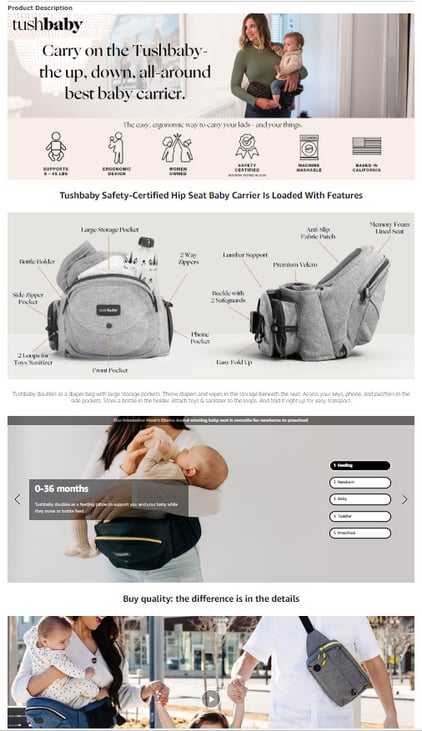
If shoppers say the product is smaller, lighter, thinner, louder, brighter, weaker, or more complicated than expected, the listing may be creating the wrong expectation.
That does not always mean the product is bad. Sometimes the page is overpromising, under-explaining, or relying on images that need better context.
If reviews show that buyers misunderstand how to use the product, sellers may need better instructions, better images, clearer bullets, or a stronger onboarding experience.
Repeated complaints can point to manufacturing problems, supplier drift, or inventory batches that need investigation.
In this way, reviews can help sellers protect margin from both sides: by increasing trust before the sale and reducing avoidable friction after the sale.
A review strategy works best when it connects to the full listing and growth strategy.
Here’s a practical framework.
Do not rely on memory. Memory is where good intentions go to lose to Slack notifications.
Use a consistent system to request reviews after eligible purchases. For Amazon sellers, FeedbackFive helps automate Amazon review requests so the process becomes part of operations instead of another manual task.
Not every product has the same review problem.
Some need more volume. Some need more recent reviews. Some need better expectation-setting. Some need product fixes. Some need fewer shoppers saying, “I thought it would be bigger,” which is almost always a sign that your images need scale context.
Track review trends at the ASIN level so you know where trust is helping conversion and where it may be quietly hurting it.
Your happiest customers often explain your value better than your internal team can.
Look for repeated phrases, benefits, objections, and use cases. Then use that insight to improve:
If customers keep praising the same benefit, make that benefit easier for future shoppers to see before they scroll into the review section.
A strong review strategy is not only about getting more reviews. It is about earning better ones.
If negative reviews cluster around delivery damage, unclear sizing, missing accessories, setup confusion, or quality inconsistency, address the root issue.
Otherwise, you are just using review requests to collect more evidence of the same problem. That is less “voice of customer” and more “publicly archived margin leak.”
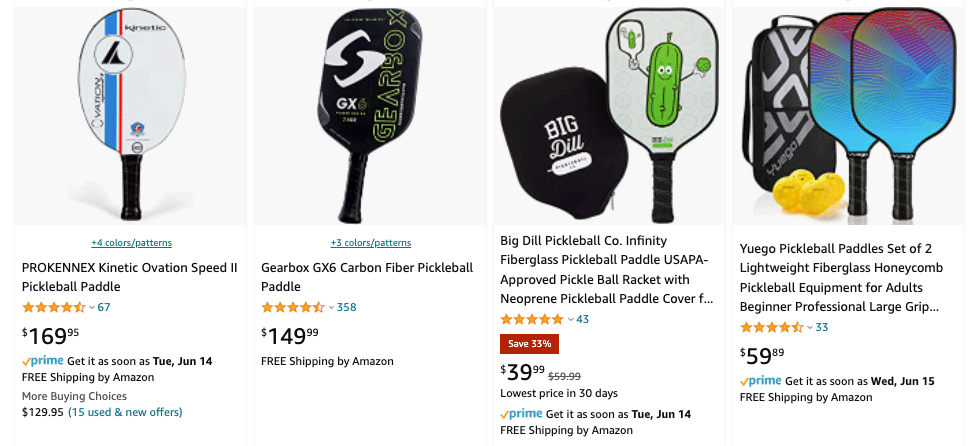
Once review volume, quality, and recency improve, sellers may have more room to test pricing with less dependence on discounts.
That might mean reducing coupon depth, shortening promo windows, testing higher everyday pricing, or using discounts more strategically around launches, seasonal spikes, or inventory needs.
The goal is not to be expensive.
The goal is to stop being unnecessarily cheap.
Discounts are not villains. They just make terrible full-time employees.
There are plenty of moments where promotions can be useful:
The issue is not using discounts.
The issue is needing discounts because shoppers do not trust the product page enough to buy without them.
Reviews help solve that deeper problem.
If you’re discounting to compete, you’re playing the hardest version of the game.
There will always be another seller willing to go lower. Another coupon. Another lightning deal. Another competitor treating margin like a decorative suggestion.
But trust gives you another lever.
A strong review profile helps shoppers feel confident. Confidence helps them choose value instead of defaulting to the lowest price. And when your product page gives shoppers enough proof to buy without waiting for a promo, your margins finally get some breathing room.
That is the real power of reviews.
They do not just help you look popular.
They help you sell with more confidence, protect pricing power, and reduce the need to bribe every conversion into existence.
Q: How do reviews reduce discount dependence on Amazon?
Reviews reduce discount dependence by giving shoppers more confidence in the product before they buy. When buyers can see proof from other customers, they may be less likely to choose only based on the lowest price. Strong reviews help sellers compete on trust, value, and confidence instead of constantly relying on coupons or promotions.
Q: Why are reviews important for protecting profit margins?
Reviews can help protect profit margins because they support conversion without requiring sellers to reduce price as aggressively. When a product has strong social proof, shoppers have more reasons to buy at the listed price. That gives sellers more flexibility to use discounts strategically instead of making them the default conversion tool.
Q: What type of reviews matter most to Amazon shoppers?
Amazon shoppers often look for reviews that are recent, detailed, relevant, and specific to their concerns. Reviews that mention product quality, ease of use, fit, durability, packaging, value, and real-world use cases can help shoppers feel more confident. Review volume matters, but review quality and recency are also important trust signals.
Q: Can sellers ask Amazon customers for reviews?
Yes, sellers can request reviews, but they must follow Amazon’s rules. Amazon’s Request a Review feature allows sellers to request a review once per order between 5 and 30 days after delivery. Sellers should avoid incentives, pressure, review gating, or language that asks only for positive reviews.
Q: How does FeedbackFive help Amazon sellers get more reviews?
FeedbackFive helps Amazon sellers automate review requests by triggering Amazon’s Request a Review button for eligible orders. Instead of manually requesting reviews order by order, sellers can use FeedbackFive to create a consistent, scalable process for requesting feedback and product reviews.
Q: Do reviews help with Amazon Ads performance?
Reviews can support Amazon Ads performance because paid traffic still needs to convert after shoppers reach the listing. A product page with stronger social proof may give shoppers more confidence to buy, which can help sellers get more value from ad traffic. Reviews do not replace smart ad strategy, but they can make the listing more persuasive once the click happens.
Q: Should Amazon sellers stop using discounts completely?
No. Discounts can still be useful for launches, seasonal promotions, inventory management, and major shopping events. The goal is not to eliminate discounts. The goal is to avoid depending on discounts as the main reason shoppers buy. Reviews help sellers build trust so promos become a strategic lever instead of a margin-draining habit.







No Comments Yet
Let us know what you think