


.png?width=50&height=50&name=feedbackfive-menu-icon(orange).png "feedbackfive-menu-icon(orange)")

Originally published on September 18, 2026, updated September 18, 2026
Menu
Join Our Email List
- Receive our monthly newsletter.
- Stay up to date on Amazon policies.
- Get tips to grow your business.
/%5BeComEngine%5DLogo-2019-linear.svg "eComEngine Logo")
 |
Review Monitoring Quickly identify review trends |
|
Review Monitoring Quickly identify review trends |

September has a funny way of making Amazon sellers feel two completely opposite things at once.
“Q4 is still months away.”
And…
“Wait. How is Q4 basically already here?”
If you manage inventory, the second reaction is closer to reality.
By September, your Q4 purchase order is no longer just a forecast. It is becoming a cash-allocation decision with consequences that may not fully show up until November.
Order too little and a profitable SKU can run dry right when demand gets interesting.
Order too much and congratulations: you’ve converted perfectly useful cash into a very expensive collection of cardboard boxes.
Neither is ideal.
The goal of Amazon Q4 inventory planning isn’t to predict every order you’ll receive between now and December 31. Unless your other business tool is a functioning crystal ball, that’s probably not happening.
The goal is to make the best inventory decisions you can with the information available today—while leaving enough flexibility and cash to react when Q4 inevitably refuses to follow your spreadsheet exactly.
That starts with building your September PO differently.
For many sellers, the inventory ordered in September is the inventory that will actually be available when November demand arrives.
That matters because Q4 order volume on seasonal, giftable, or promotion-heavy SKUs can run several times the average weekly volume seen during the prior quarter.
But that does not mean the answer is:
“Q4 is bigger, so multiply everything by three.”
That’s how inventory planning turns into inventory gambling.
Different SKUs behave differently. Different suppliers have different lead times. Different products carry different margins. And the SKU that generated the most revenue last quarter may not be the SKU where you should put your next $10,000.
Amazon’s own 2026 holiday guidance reinforces why the timing matters. Amazon says its fulfillment center teams focus heavily on receiving holiday inventory during September and October before shifting toward processing customer orders in November and December.
For Black Friday Week and Cyber Monday, Amazon currently lists 2026 Prime-badge inventory-arrival deadlines of October 14 for AWD shipments, October 21 for FBA shipments using minimal shipment splits, and October 28 for FBA shipments using Amazon-optimized shipment splits.
And there’s an important word in that sentence:
Arrival.
Those are not “place your purchase order” dates.
Your supplier still needs to make or prepare the inventory. It may need to travel across an ocean, clear customs, reach a warehouse, get prepped, ship into Amazon, and become sellable.
Suddenly, September doesn’t look all that early.
Instead of asking:
“When should I place my last big Q4 order?”
Start with:
“When does this inventory need to be available for sale?”
Then work backward.
For each SKU, account for:
If the math says a purchase order placed three weeks from now probably won’t become sellable inventory until December 12, it probably shouldn’t be part of your Black Friday strategy.
That ship has not just sailed.
It may literally be on a ship.
The natural place to begin your Q4 PO is expected demand.
Look at recent sales velocity, seasonality, historical Q4 performance, upcoming promotions, planned advertising, current trends, and any meaningful changes to the business.
But avoid using one simple trailing average as if September through December are four completely ordinary months.
They aren’t.
A SKU averaging 100 units per week during summer may sell dramatically more during peak. Another SKU might barely move at all. Your job is to identify where there is credible evidence that demand should change.
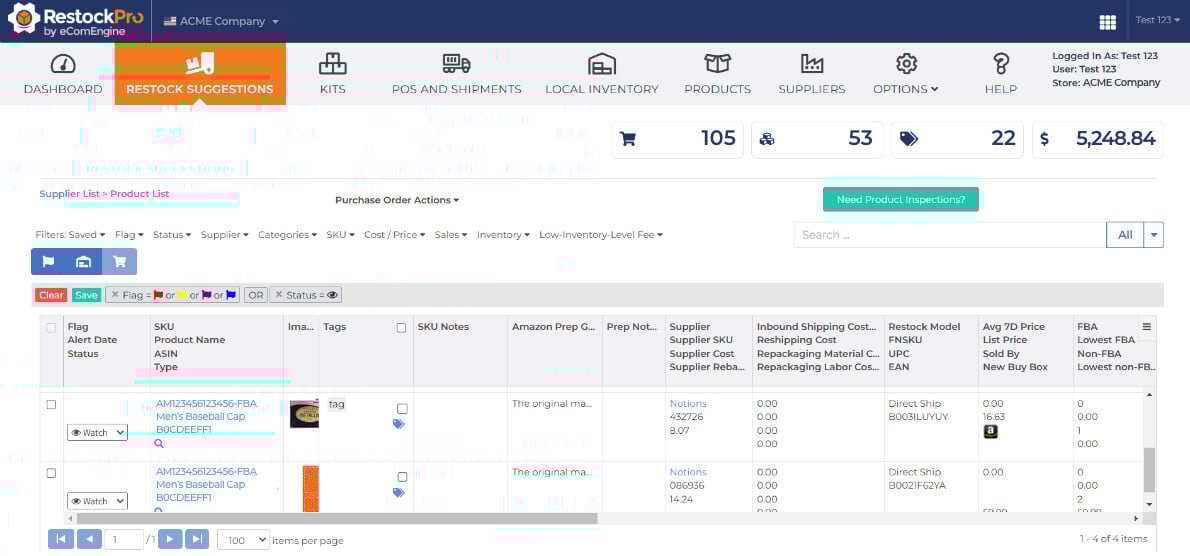
A useful starting point is:
Then account for:
The key word is expected.
Forecasting gives you a planning range, not a promise.
Your PO should reflect that uncertainty instead of pretending it doesn’t exist.
Here’s where the September Q4 PO gets much more useful.
Don’t look at your PO as one giant number.
Split your planned inventory investment into two buckets:
Inventory supported by strong evidence that you are likely to need it.
Normal replenishment demand, historically reliable Q4 lift, committed promotions, proven seasonal winners, inventory needed before projected stockout.
Additional inventory purchased to capture possible upside.
Aggressive promotional forecasts, unusually high seasonal assumptions, new-product bets, speculative ad-driven growth, extra buffer beyond normal safety stock.
Why separate them?
Because a $75,000 purchase order sounds like one decision.
It isn’t.
Maybe $48,000 represents inventory you have strong reason to believe you’ll need.
The other $27,000 might represent upside assumptions.
Those dollars deserve a different level of scrutiny.
The question isn’t:
“Could this SKU sell more?”
Almost any SKU could sell more.
The better question is:
“Is the expected return worth committing more cash to this SKU right now?”
That forces you to consider what happens if your optimistic forecast is wrong.
If the extra inventory sells: great.
If it doesn’t, what happens to that cash?
How long will it sit?
What storage costs could it create?
Could that money have funded a faster-moving or more profitable SKU instead?
And most importantly:
Will you wish you still had that cash in November?
That last question deserves more attention than it usually gets.
One of the core ideas behind RestockPro Plus is simple:
Every SKU is its own business.
That means your best-selling SKU does not automatically get first dibs on your inventory budget.
Imagine two products.
It sells quickly. Revenue looks great. Everyone loves seeing it at the top of the sales report. But margins are getting thinner. Fees are eating into the return. Advertising costs are rising. And putting another $20,000 into inventory only generates a modest return on that cash.
It sells fewer units. It never gets invited to speak at the company holiday party. But it generates stronger profit per unit and a better return on the dollars you invest in inventory.
If your purchasing process only asks, “What’s selling fastest?”, SKU A probably wins.
If you ask, “Where is the next inventory dollar most likely to produce a healthy return?”, the answer can change.
That’s the distinction between ordinary replenishment and profit-aware replenishment.
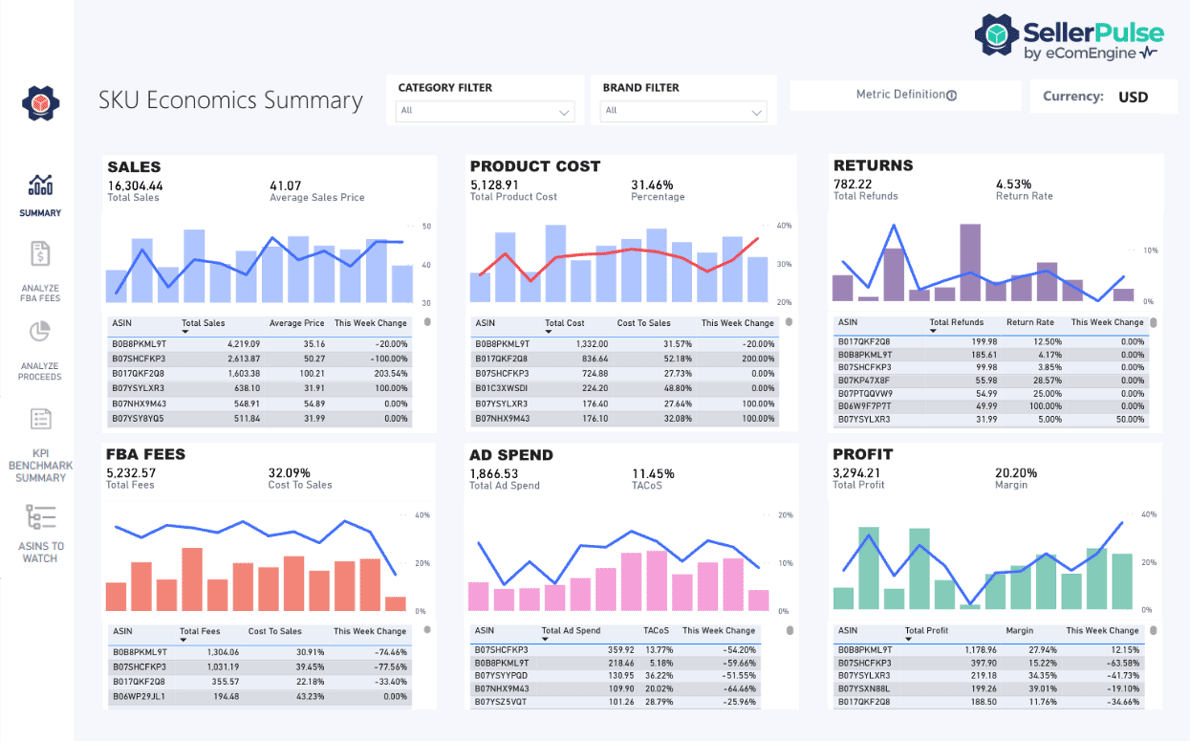
RestockPro Plus is designed around this exact connection: RestockPro continues to support forecasting, restock recommendations, purchase orders, shipments, supplier management, and inventory planning, while RestockPro Plus adds SKU Economics to bring profitability into the reorder decision.
This sounds obvious.
It often isn’t.
Sellers frequently build an inventory plan first and figure out the cash implications afterward.
For Q4, reverse that.
Ask:
How much cash can the business responsibly commit to inventory without compromising everything else Q4 requires?
Inventory is not your only holiday expense.
You may also need cash for:
And 2026 adds another reason to protect margin carefully: Amazon says holiday peak fulfillment fees will apply from October 15, 2026 through January 14, 2027, with an average $0.32-per-unit increase over non-peak rates, while the 3.5% fuel and logistics-related surcharge will apply on top of those peak fees.
In other words, the number on your supplier PO is not the full cost of putting that inventory to work.
Give yourself a maximum inventory commitment.
Then divide it conceptually into three layers:
Fund the SKUs where the evidence for replenishment is strongest.
Allocate additional cash to SKUs where higher Q4 demand is reasonably likely and the economics remain attractive.
Only then consider more speculative purchases based on aggressive promotion, advertising, or seasonal-growth assumptions.
If Layer 1 and Layer 2 consume the available budget, Layer 3 does not magically become free.
That is what “budget” means.
Before committing cash, run your proposed PO through at least three scenarios.
| Scenario | Question to Answer |
|---|---|
| Base Case | What happens if Q4 demand roughly matches the forecast? |
| Upside Case | What happens if peak demand significantly exceeds expectations? |
| Downside Case | What happens if demand is weaker, later, or less profitable than expected? |
The downside scenario is especially important.
Suppose a SKU is projected to sell 3,000 units during your coverage period.
Your optimistic scenario says 4,500.
Before ordering those extra 1,500 units, ask:
If those units do not sell during Q4, am I comfortable carrying them into Q1?
If the answer is yes because the product has stable year-round demand and healthy economics, the additional inventory may be reasonable.
If the answer is:
“Well… it’s a Christmas-themed inflatable reindeer wearing 2026 sunglasses…”
Maybe proceed with caution.
The downside case tells you how expensive being wrong could become.
A strong Q4 PO isn’t just about finding what to buy.
It’s also about identifying what not to buy.
Before sending the order, look for SKUs that fall into categories like:
One of the easiest Q4 mistakes is reordering a SKU because it has always been reordered.
Q4 is a particularly expensive time for autopilot.
The RestockPro Plus launch strategy puts this distinction at the center of the product story: sellers need to know both whether they need more inventory and whether the SKU is profitable enough to justify buying more.
Those are different questions.
Your PO should answer both.
Once you’ve established your baseline needs and inventory budget, rank purchase decisions based on how strongly each SKU deserves additional cash.
A simple decision framework might look like this:
| Priority | SKU Profile | Q4 Action |
|---|---|---|
| Priority 1 | Strong demand + strong economics + stockout risk | Fund first |
| Priority 2 | Strong demand + acceptable economics | Replenish carefully |
| Priority 3 | Moderate demand + strong economics | Evaluate opportunity |
| Priority 4 | Strong demand + weak economics | Review before committing more cash |
| Priority 5 | Weak demand + weak economics | Avoid adding inventory unless there is a compelling reason |
This is where inventory planning becomes capital allocation.
Your inventory budget is finite.
Every dollar committed to SKU A is a dollar you cannot commit to SKU B.
So instead of asking:
“How many units should I reorder?”
Ask:
“Where should my next inventory dollar go?”
That is a much better Q4 question.
Traditional inventory planning tends to emphasize:
All important questions.
But they leave out another one:
Is this SKU financially worth replenishing?
RestockPro Plus brings SKU-level economics into the inventory-planning workflow so forecasting and replenishment decisions can be evaluated alongside profitability.
The objective isn’t another report to stare at while drinking your fourth coffee of the morning.
It’s a better purchase decision.
The RestockPro Plus strategy specifically positions the product as the way sellers can evaluate expected demand, current stock, lead time, reorder quantity, SKU-level margin, fees and costs, inventory investment, and expected return as part of the purchase-order process.
That becomes especially valuable in September, when inventory decisions get bigger, lead times matter more, and cash committed today may not generate a return for weeks or months.
Before approving your final major Q4 inventory commitment, make sure you can answer these questions for each significant SKU:
If you cannot answer several of those questions, you probably aren’t ready to send the PO.
And that is exactly the kind of problem you want to discover before the supplier gets your money.
Not after 4,000 units arrive.
The goal isn’t to enter Q4 with the most inventory.
It’s to enter Q4 with the right inventory.
Enough inventory to protect your best opportunities.
Enough flexibility to respond when demand changes.
Enough cash left to fund the rest of the business.
And enough visibility into SKU economics to know when a reorder is helping the business versus simply adding more revenue and more boxes.
September is where those decisions start becoming real.
Your forecast tells you where inventory may be needed.
Your economics tell you where cash may be worth committing.
Put the two together, and your final Q4 PO stops being a guessing exercise.
It becomes a business decision.
Q: When should Amazon sellers place their final Q4 purchase order?
There is no universal final Q4 purchase-order date because supplier production time, transportation, prep, Amazon receiving, and safety buffers vary by seller and SKU. Work backward from the date inventory must be sellable and subtract your full replenishment lead time. For many products with longer lead times, September can be the final practical window for inventory intended to support November demand.
Q: How much inventory should I order for Amazon Q4?
Start with expected weekly demand, adjust for credible seasonal or promotional changes, determine the number of weeks you need to cover, and subtract sellable and confirmed inbound inventory. Then add appropriate safety stock. Avoid applying one blanket Q4 multiplier across your entire catalog because demand patterns and SKU economics can differ significantly.
Q: What is the difference between confirmed and elective inventory?
Confirmed inventory is supported by strong evidence that you are likely to need it, such as established sales velocity, predictable seasonal demand, or a projected stockout. Elective inventory is additional inventory purchased to capture possible upside from higher seasonal demand, advertising, promotions, or other less-certain assumptions. Separating the two helps sellers understand how much cash is supporting likely demand versus speculative growth.
Q: Should I always reorder my best-selling Amazon SKU first?
No. A best-selling SKU can generate substantial revenue while producing weak margins or a poor return on the cash invested in inventory. Reorder decisions should consider both expected demand and SKU economics so inventory dollars can be directed toward products that offer an attractive combination of demand, profitability, and inventory efficiency.
Q: How do supplier lead times affect Q4 inventory planning?
Supplier lead time determines how late you can wait before a purchase order risks arriving after the selling opportunity. Calculate the entire timeline, including production, freight, customs when applicable, prep, forwarding, Amazon receiving, and a delay buffer. Then work backward from the date the inventory needs to be available for customers.
Q: How much safety stock should Amazon sellers carry during Q4?
Q4 safety stock should reflect demand variability, replenishment lead time, supplier reliability, receiving risk, and the financial consequences of stocking out. There is no ideal percentage for every SKU. Higher-margin products with predictable peak demand and long replenishment cycles may justify more protection than lower-margin or highly uncertain seasonal products.
Q: How can RestockPro Plus help with Q4 purchase-order planning?
RestockPro Plus connects RestockPro’s forecasting and replenishment capabilities with SKU Economics, allowing sellers to consider both inventory need and profitability when planning reorders. That can help sellers determine which SKUs need additional inventory, which products deserve more cash, and where a purchase order may create unnecessary inventory risk.
Your Q4 inventory budget has one job:
Put cash where it has the best opportunity to work.
RestockPro Plus connects inventory forecasting, replenishment planning, purchase orders, and SKU Economics so you can evaluate what needs to be reordered—and whether it deserves another dollar of inventory investment.
Don’t build your September PO around what sold the most.
Build it around what your business should own next.








No Comments Yet
Let us know what you think