


.png?width=50&height=50&name=feedbackfive-menu-icon(orange).png "feedbackfive-menu-icon(orange)")
Originally published on July 22, 2026, updated July 22, 2026
Menu
Join Our Email List
- Receive our monthly newsletter.
- Stay up to date on Amazon policies.
- Get tips to grow your business.
/%5BeComEngine%5DLogo-2019-linear.svg "eComEngine Logo")
 |
Review Monitoring Quickly identify review trends |
|
Review Monitoring Quickly identify review trends |

Here's an uncomfortable truth about Amazon selling in 2026: your top-line sales dashboard is lying to you. Not maliciously — it's just not built to tell you the whole story.
Revenue is up. Units are moving. Everything looks healthy. And yet your bank account isn't reflecting any of that supposed health, because somewhere between "sale" and "profit," a small army of fees, returns, and ad dollars quietly picked your pocket.
This is the part of running an Amazon business that nobody puts on a highlight reel: the slow, invisible erosion of margin. Not one catastrophic event — just death by a thousand line items. And in 2026, those line items are multiplying.
Let's pull back the curtain.
If you sell via FBA, you already know fulfillment fees aren't exactly shrinking year over year. But April 2026 brought a fresh wrinkle: Amazon began applying a 3.5% fuel and logistics-related surcharge to FBA fulfillment fees in the U.S. and Canada, starting April 17, 2026.[Supply Chain Dive] [CNBC]
On paper, 3.5% sounds like a rounding error. In practice? It works out to roughly 17 cents extra per unit, with the exact amount shifting based on your item's size and weight. The surcharge is calculated on your fulfillment fee, not your sale price — which, depending on how you look at it, is either a small mercy or a technicality that still costs you money either way.[CNBC] [Amazon]
Here's why this matters more than it sounds like it should: 17 cents on its own is nothing. Multiplied across thousands of monthly units, it becomes a real number on your P&L — and it's stacking on top of fees that were already climbing. Run a 10,000-unit month and you're looking at an extra $1,700 in fulfillment costs you weren't paying in March. That's not "rounding error" money. That's "should I be raising prices" money.[Seller Essentials]
And here's the part Amazon's announcement didn't say out loud but every seasoned seller is thinking: "temporary" surcharges have a habit of becoming permanent fixtures of the fee structure. History (looking at you, 2022) backs that skepticism up.[Seller Essentials]
The takeaway: if you haven't recalculated your true fulfillment cost per ASIN since April 17, your margin numbers are already out of date. And outdated margin numbers are how profitable-looking products quietly become break-even ones.
Returns rarely get the spotlight treatment in seller strategy conversations, but they deserve one. Every returned unit drags your margin down in at least three ways: the lost sale, the return shipping cost, and (frequently) a unit that comes back damaged, unsellable, or destined for liquidation at pennies on the dollar.
The sneaky part? Return rates vary wildly by category and by ASIN — which means your "average return rate" metric is basically useless. A 5% blended return rate across your catalog could mean one SKU sitting comfortably at 1% while another is quietly bleeding out at 22%. If you're only looking at the average, you'll never find the 22%.
This is exactly the kind of leak that hides in plain sight: the SKU still "sells well," the top-line revenue still looks fine, and the return-driven margin damage never shows up unless you go looking for it at the ASIN level.
Paid visibility on Amazon isn't optional anymore — it's table stakes. Amazon's advertising business has only continued growing, with ad revenue lines reaching roughly $68.6 billion in 2025. That's not a niche tactic. That's a marketplace-defining force, and it means your competitors are almost certainly outbidding, outspending, or outsmarting you on at least a few keywords right now.[Nova Analytics]
Here's where it gets dicey for sellers: ad spend is easy to track in isolation (cost per click, ACoS, impressions) but brutally hard to evaluate in context. A campaign with a "great" ACoS on a low-margin SKU can still be quietly unprofitable, while a "mediocre" ACoS on a high-margin product might be perfectly healthy. Without tying ad spend to actual product economics — landed cost, fees, returns, the whole picture — you're optimizing for a number that doesn't actually tell you whether you're making money.
This is where TACoS (Total Advertising Cost of Sale) becomes the more honest metric, because it forces ad spend to answer to your entire revenue, not just the ad-attributed slice. But even TACoS only tells half the story if you're not layering it against true net profit per SKU.
Individually, each of these leaks — fee creep, returns, inefficient ad spend — is manageable. Stacked together, across dozens or hundreds of SKUs, they become the reason a seller can have record-high revenue and a suspiciously unimpressive bank balance.
The fix isn't "spend less" or "raise prices and hope." It's visibility. You need to see sales, product cost, returns, FBA fees, ad spend, TACoS, and net profit — by ASIN, side by side, without exporting six reports and building a spreadsheet at 11pm.
This is exactly the gap SellerPulse's SKU Economics feature was built to close. Instead of guessing which products are quietly underperforming, SKU Economics gives you a clear, product-level view of:
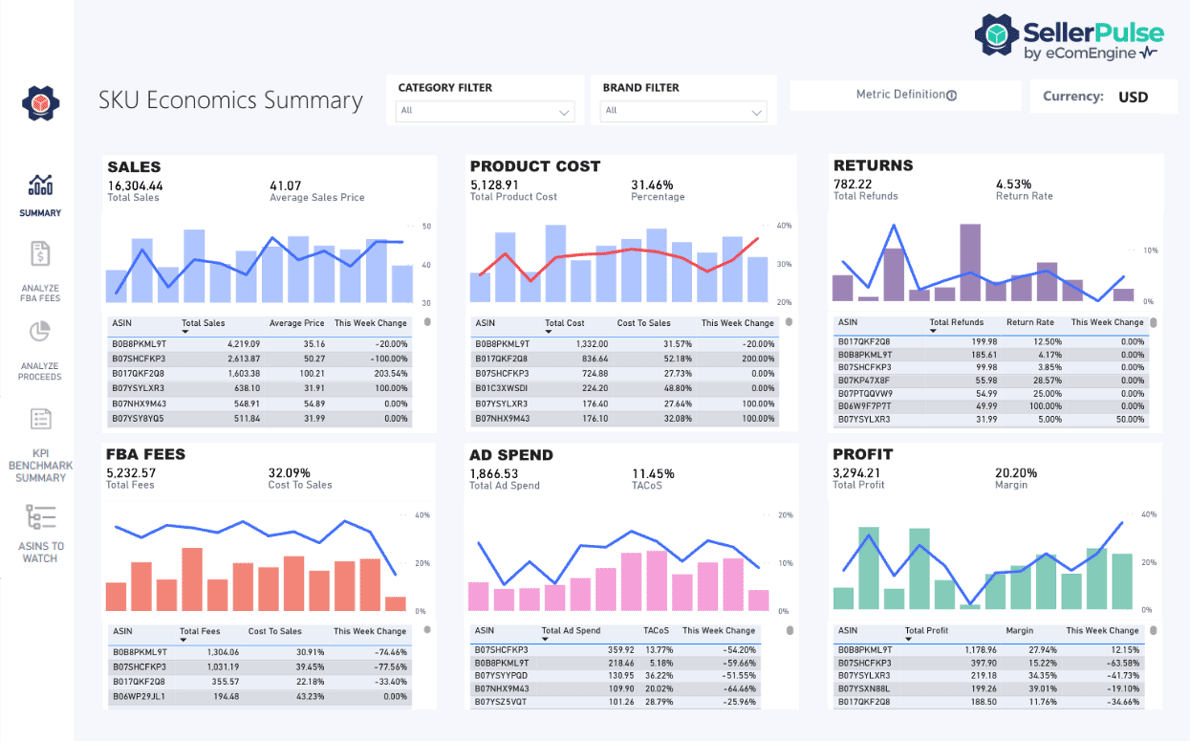
Instead of asking "how are sales doing?" you start asking the better question: "how is profit doing — by SKU?" That's the question that actually protects your Q4.
Q: What is causing FBA fees to increase in 2026?
Amazon added a 3.5% fuel and logistics-related surcharge to U.S. FBA fulfillment fees starting April 17, 2026, citing rising fuel and operating costs. The surcharge is calculated on fulfillment fees rather than item sale price, and on average adds about 17 cents per unit, varying by item size and weight.
Q: How much extra does the 2026 FBA fuel surcharge cost sellers?
The surcharge averages roughly 17 cents per unit for standard FBA shipments in the U.S. For high-volume sellers, this can add up to thousands of dollars in additional monthly fulfillment costs, even though the per-unit impact looks small in isolation.
Q: Why do high-revenue products sometimes have low or negative profit margins?
A product can generate strong revenue while still losing money once FBA fees, return-related losses, and advertising spend are factored in. Revenue dashboards typically show top-line sales, not the layered costs that erode margin at the SKU level, which is why profit and revenue can tell very different stories for the same product.
Q: How do returns impact Amazon seller profitability?
Returns reduce profit through the lost sale, return shipping costs, and the frequent loss of resale value on returned units. Because return rates vary significantly by ASIN, a low average return rate across a catalog can mask individual products with much higher, more damaging return rates.
Q: What is TACoS and why does it matter more than ACoS for profitability?
TACoS (Total Advertising Cost of Sale) measures ad spend against total revenue rather than just ad-attributed sales, giving a more complete picture of advertising efficiency. A campaign can show a strong ACoS while still being unprofitable at the product level if TACoS and net margin aren't considered together.
Q: How can Amazon sellers track true profit by product instead of just sales?
Sellers can track true profit by reviewing sales, product cost, returns, FBA fees, ad spend, TACoS, and net profit at the individual ASIN level rather than relying on catalog-wide averages. Tools like SellerPulse's SKU Economics feature consolidate these metrics into a single per-product view.
Q: Is Amazon's 2026 FBA fuel surcharge permanent?
Amazon has described the surcharge as temporary but has not provided an end date. Industry observers have noted that similar "temporary" surcharges in the past, including a 2022 fuel and inflation surcharge, were eventually absorbed into Amazon's base fee structure rather than removed.





No Comments Yet
Let us know what you think